ECG for Everyday Practice: Why Are We Still Treating It as a Specialist Tool?
Welcome to a new edition of our Monthly feature topic. We’re excited to launch our new featured series: ECG for Everyday Practice. Over the coming months, we’ll explore how electrocardiograms (ECGs)—a routine powerhouse in human medicine—can transform your daily veterinary workflow. If you’re a general practitioner juggling back-to-back consults, a hospital owner streamlining operations amid rising costs, or an existing CardioBird user ready to expand your toolkit, this series is crafted for you. Let’s begin with a simple question: Why does ECG remain a specialist luxury in veterinary clinics when it could be your everyday ally in primary care?
Consider the contrast. In human hospitals, ECG is ubiquitous and embedded in standard protocols: a quick gatekeeper before anesthesia, a triage tool for nonspecific chest pain or syncope, and a cornerstone of geriatric checkups. Landmark studies, including data from the American Heart Association, indicate over 90% of U.S. hospitals integrate ECG into primary workflows. This approach catches subclinical arrhythmias early—think atrial fibrillation or ventricular ectopy—guiding immediate management decisions without mandatory cardiologist referrals every time. The result? Faster, safer care and fewer escalations.
Yet veterinary medicine tells a different story. ECG acquisition in general practice hovers below 20%, typically reserved for board-certified cardiologists or advanced internal medicine specialists. Primary care clinics—the frontline for 80% of companion animal cases—often rely on auscultation, radiographs, or echocardiography referrals alone. Why the gap? From my decade-plus observing the veterinary market firsthand—first as a clinical electrophysiology professor in human medical school, then as founder of CardioBird after losing my cat to undetected heart disease—three practical barriers consistently emerge.
Barrier 1: No dedicated manpower.
Human clinics delegate routine ECGs to trained technicians or nursing staff, freeing physicians for high-value diagnostic and therapeutic tasks. This automation streamlines workflows and matches skill levels to needs. Veterinary practices, however, lack this mature ecosystem. Recent industry surveys highlight chronic staffing shortages as the top pain point for 70% of veterinarians—exacerbated by burnout and competition for talent. Every ECG thus becomes an extra load on you, the practitioner, amid already packed days of surgeries, consults, and client communications.
Barrier 2: Human-centric equipment.
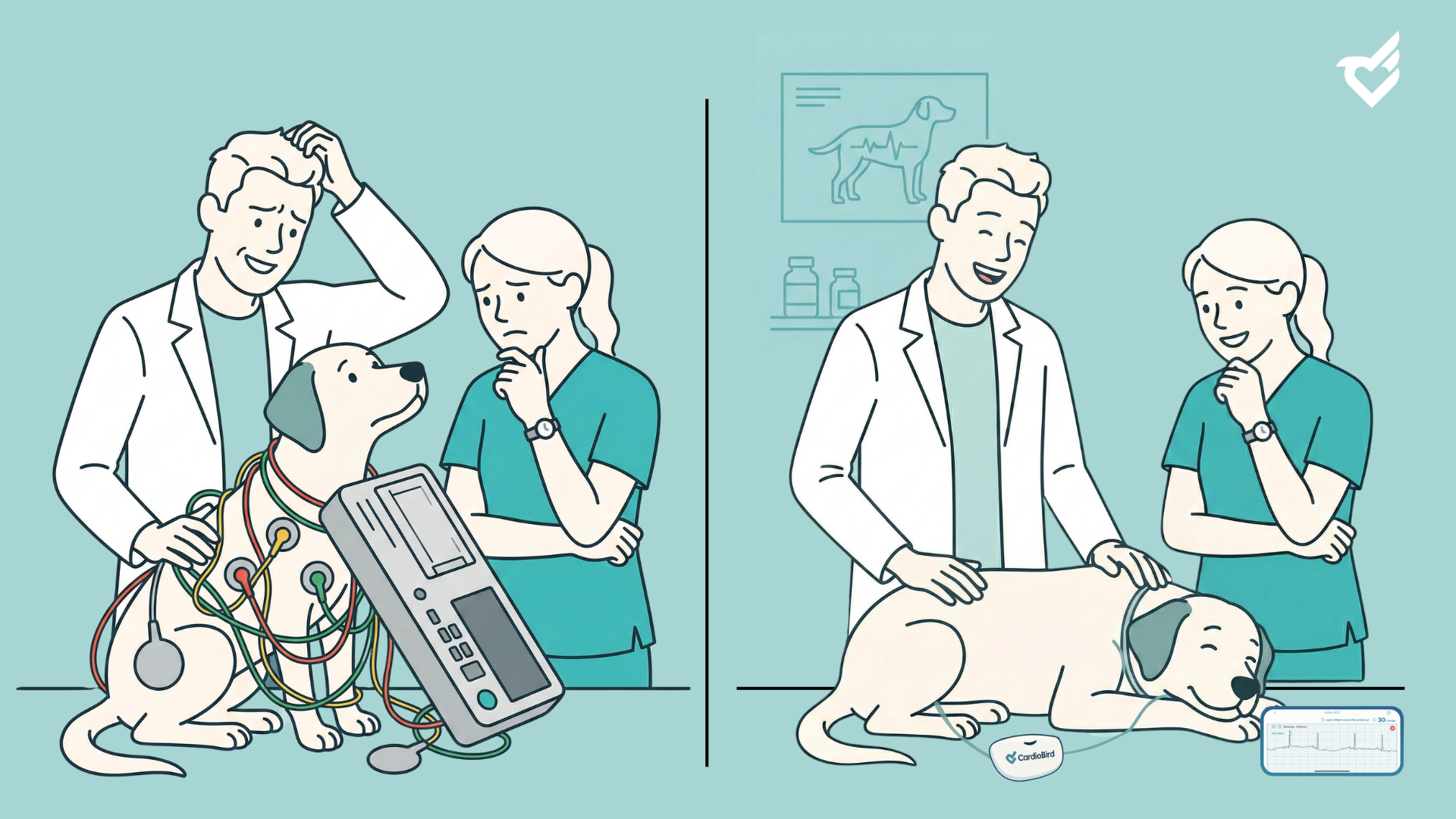
Most veterinary ECG machines are lightly modified human models, optimized for cooperative, smooth-skinned patients lying still on an exam table. They demand shaved patches on precise anatomical sites, multi-person restraints to manage wiggly dogs or cats, and prolonged stillness for clean signals. The typical workflow? One to two assistants hold the patient securely while you position leads, record the trace, print strips, and—if time allows—review for abnormalities. This setup clashes fundamentally with veterinary reality: diverse species (from tiny kittens to large breeds), thick fur coats, and inherent stress responses that degrade signal quality.
Barrier 3: Training spread thin across a broad field.
Veterinary curricula must cover an immense spectrum—from equine orthopedics to exotic reptile medicine—prioritizing versatile skills for real-world practice. Focused companion animal cardiology, including ECG nuances like recognizing species-specific rhythms or conduction delays, typically receives attention only in advanced residency programs. In rapidly maturing regions like Asia, where veterinary ecosystems are still scaling, this leaves less opportunity for routine ECG exposure during core training. The practical outcome? Hesitation to incorporate it when schedules are tight, often leading to referrals or deferral.
Clinical Consequences: Undetected Early Signs
These barriers aren’t abstract—they manifest in everyday cases. Picture a 10-year-old Labrador presenting with lethargy and a grade 2/6 left apical murmur. Without ECG, you might proceed to empiric meds, echo referral, or watchful waiting based on exam and history alone. But a simple 30-second trace could reveal atrial fibrillation with a rapid ventricular response—prompting immediate adjustments like rate control, anticoagulation considerations, or anesthesia deferral to avert risks. These missed opportunities compound daily: undetected bradyarrhythmias in senior wellness exams, ventricular ectopy lurking before elective surgeries, or sinus tachycardia masking systemic pain or dehydration.
Early detection doesn’t just improve outcomes; it builds client trust and differentiates your practice.
The Solution: Innovation by CardioBird
The good news? Structural facts like manpower limits or curriculum breadth won’t vanish overnight. But problems can be solved through innovation. At CardioBird, we’ve engineered an animal-first solution from the ground up:
- Stress-free, fur-friendly sensors that attach in seconds without shaving or heavy restraint.
- Record high-quality data effortlessly even in a busy consult room, upload via app, and receive an AI-powered report—trained on the world’s largest veterinary ECG database—in under 15 minutes.
- Each report delivers specialist-level detail: precise rhythm analysis, interval measurements, differential diagnoses, and actionable next steps—from targeted further tests to tailored management protocols.
Best of all, it removes the interpretation burden, letting you focus on what you do best.
Act Now
This isn’t theory—it’s proven in clinics worldwide. Early CardioBird adopters now routinely integrate ECG into wellness checks, pre-anesthetic checks, and senior pet protocols—catching subclinical issues early, reducing referral volumes, building client loyalty through proactive care, and unlocking new revenue streams.
Ready to reframe ECG as your daily ally in primary care?
Non-users: Download the app today (QR below), email service@cardiobird.com, and start your free trial.
Existing users: Pick one workflow—like pre-anesthetic screening—and add ECG this week. Contact us at service@cardiobird.com for customized implementation support.

Facts can’t be changed—but your practice can. Join the shift today.
Elevate your practice with CardioBird: Science and Tech, side by side.
Learn more at www.cardiobird.com

| Scan QR code for CardioBird app download